

Recently, one of our Twin Cities partners experienced a type of cyberattack known as a lateral attack, often referred to by security professionals as lateral movement.
Like many organizations across Minneapolis, Saint Paul, and the surrounding metro area, they relied on Microsoft 365, shared business systems, and cloud-based applications to keep daily operations running smoothly.
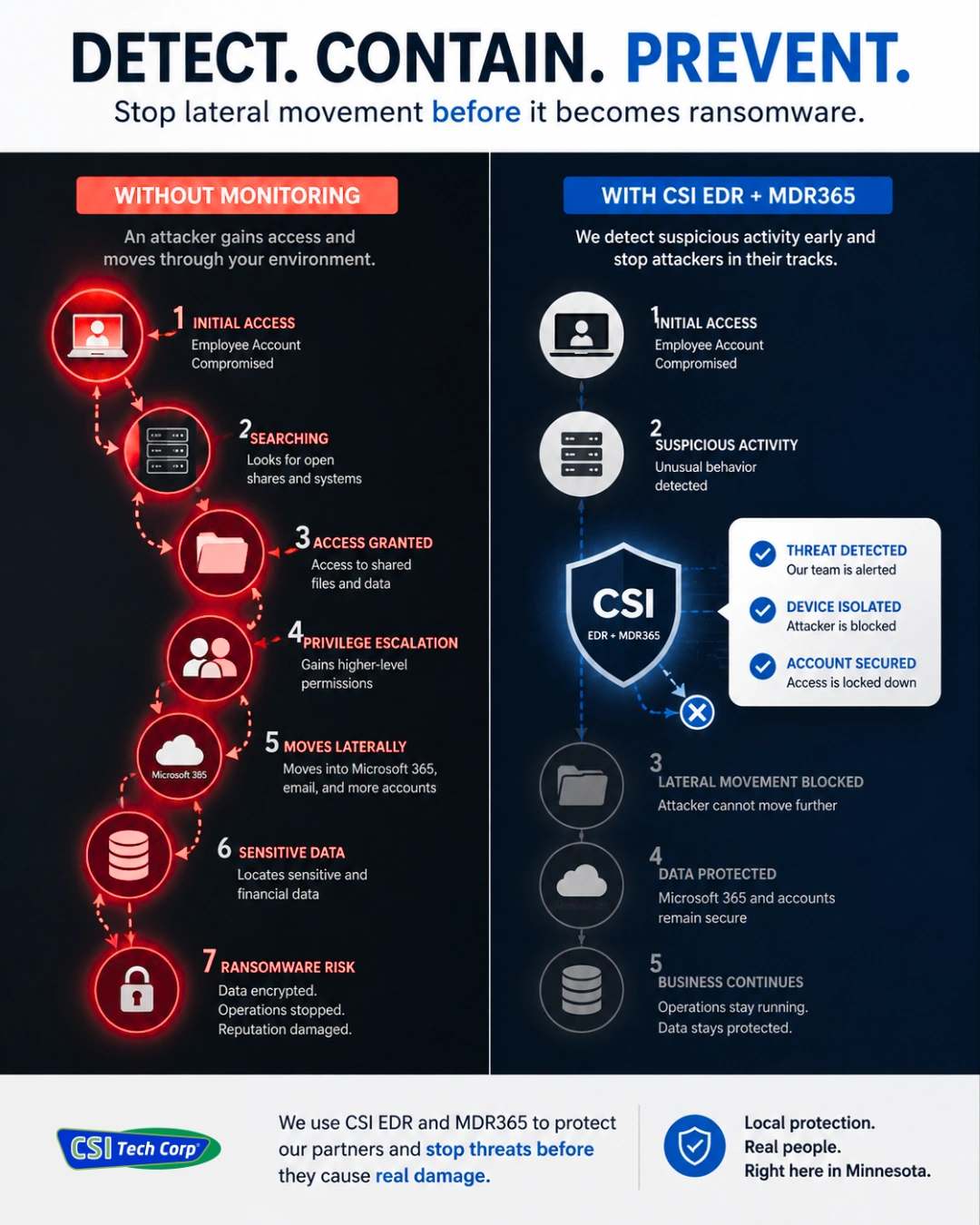
This occurs when a bad actor gains initial access to a network, computer, or user account and then begins moving through the environment in search of higher-value targets. Their objective is often to gain additional permissions, access sensitive information, compromise more accounts, and expand their control over the organization.
Think of it as an intruder entering a building through one unlocked door and then moving room to room looking for the most valuable assets. Unfortunately, this is exactly what happened to one of our partners.
The attacker successfully gained an initial foothold and began moving through the environment. Fortunately, our team was able to identify the activity while it was still in progress. By detecting the behavior early, we were able to stop the attack before additional damage occurred and before the attackers had an opportunity to potentially encrypt systems as part of a ransomware event.
This incident highlights an important reality about modern cybersecurity: the greatest risk is often not the initial breach itself, but what happens afterward if suspicious activity goes unnoticed.
Watch How Lateral Movement Works
Our short video demonstrates how attackers move through an environment after gaining initial access and why early detection is critical to preventing larger security incidents.
Why This Matters for Organizations
Across the Twin Cities
Many local organizations assume cyberattacks primarily target large corporations.
In reality, attackers frequently target small and midsize businesses, nonprofits, healthcare providers, legal firms, accounting practices, and professional service organizations throughout the Twin Cities.
Organizations in Minneapolis, Saint Paul, Bloomington, Eden Prairie, Maple Grove, Plymouth, Woodbury, Eagan, and surrounding communities often depend on the same technology platforms used by larger enterprises. Microsoft 365, cloud file sharing, remote access tools, and business applications help teams stay productive, but they also create opportunities for attackers when accounts or devices become compromised.
The question is no longer whether an organization is large enough to be targeted.
The more important question is whether suspicious activity can be detected before it spreads.
How We Responded
Following the incident, CSI implemented both our CSI EDR and MDR365 solutions to help clean up affected systems and provide ongoing visibility into the environment.
These solutions allow our team to continuously monitor devices, user accounts, and Microsoft 365 activity for signs of suspicious behavior.
More importantly, they help us respond quickly when unusual activity is detected.
If a threat is identified, the CSI team can immediately investigate alerts, isolate a device, secure a user account, or lock down a Microsoft 365 mailbox before additional damage can occur.
The goal is simple: identify threats early and contain them before they become business disruptions.
Why CSI Recommends EDR and MDR365
Many organizations focus on preventing attacks, which is important.
However, today’s threat landscape requires organizations to assume that attackers may eventually find a way in. What matters most is how quickly suspicious activity can be detected and contained.
That is why CSI strongly recommends implementing both EDR and MDR365 as part of a layered cybersecurity strategy.
Together, these solutions provide visibility into what’s happening across devices and Microsoft 365 environments while giving our team the ability to respond when something doesn’t look right.
For business owners, nonprofit leaders, healthcare practices, legal firms, and other organizations throughout Minnesota, early detection can mean the difference between a minor security incident and a major operational disruption.