
Across Minneapolis-St.Paul Twin Cities area, more businesses and nonprofits are starting to use AI tools in their daily work. From drafting emails to summarizing documents, platforms like ChatGPT, Microsoft Copilot, and Google Gemini can save time and reduce manual tasks. (Even though Microsoft Copilot says your data is private, it’s smart to stay cautious anyway).
But there’s one important detail that often gets overlooked:
AI tools are not designed to be private workspaces.
Why “AI Is Not Private”
Most AI tools are cloud-based systems, which means organizations often have limited visibility into how submitted information is processed or stored. Employees may unintentionally paste internal notes, draft documents, or business discussions into AI tools without realizing the potential risk.
For businesses and nonprofits in Minneapolis–St. Paul, even small data exposure issues can affect client trust, internal operations, or compliance requirements. AI can still be useful, but it should be treated as a public-facing tool rather than a private workspace.
The safest rule is simple: if the information is not public, it should not be shared with AI tools.
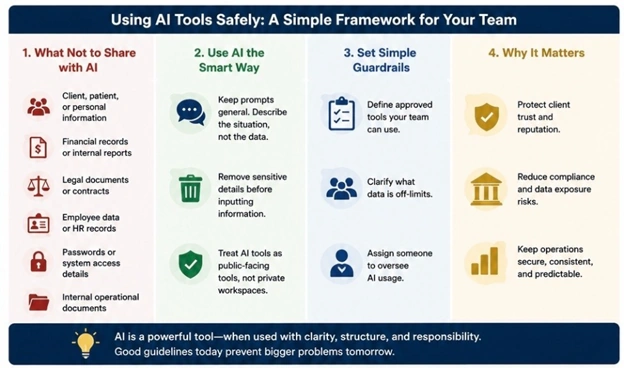
What Your Team Should Never Share with AI
Organizations should be especially careful with information connected to clients, employees, finances, or day-to-day operations. Even routine materials, like meeting summaries, internal planning notes, pricing discussions, or vendor communications, can contain details that were never meant to leave the organization.
Teams should also avoid sharing anything tied to security systems, account access, confidential agreements, or regulated information. In many cases, employees may not realize that “small” details can still expose sensitive context when combined together.
Creating awareness around what stays internal helps reduce unnecessary risk and keeps AI use practical, responsible, and easier to manage across the organization.
A Practical Way to Use AI Safely
AI can still be useful, but it needs structure. Here’s what we recommend to organizations:
1. Keep Prompts General
Instead of using real data, describe the situation in broad terms.
Example:
- Not recommended: “Summarize this client contract”
- Recommended: “Summarize a standard service agreement structure”
2. Remove Sensitive Details
If you must use real examples, remove anything identifiable.
3. Set Simple Internal Guidelines
You don’t need a complex policy. Start with something clear and practical:
- What tools are approved
- What data is off-limits
- Who is responsible for oversight
Why AI Oversight Matters for Businesses and Nonprofits
Many organizations across Minneapolis and St. Paul rely on small teams where employees often handle multiple responsibilities at once. Because of that, AI tools can quickly become part of everyday work without much planning, review, or oversight.
The challenge is not simply using AI, it’s making sure teams understand where convenience should stop and caution should begin. Without clear expectations, different employees may use AI tools in completely different ways, creating inconsistency across the organization.
For nonprofits, healthcare providers, legal offices, and small businesses, even minor mistakes can create operational headaches, reputational concerns, or unnecessary compliance complications. A few simple guidelines early on can help organizations avoid larger problems later while still allowing teams to benefit from AI responsibly.
How CSI Tech Corp Helps
At CSI Tech Corp, we have worked with local organizations across Minnesota since 2004 to make technology predictable and secure.
When it comes to AI adoption, we help you:
- Define simple, practical usage policies
- Align AI tools with your existing cybersecurity standards
- Ensure your team understands what’s safe and what’s not
- Integrate AI into workflows without adding risk
This is not about limiting your team. It’s about giving them clarity so they can use tools confidently
When It’s Time to Take a Closer Look
Short conversation now can prevent bigger issues later. If your team is already using AI tools, it’s worth reviewing:
- Do we have clear guidelines?
- Do employees know what they should not share?
- Are we protecting sensitive information consistently?
Let’s Keep It Simple and Secure
Technology should support your mission, not complicate it. If you’re unsure how AI fits into your organization safely, we can help you put the right structure in place.
Need help creating AI guidelines for your organization?
We are a local Minnesota team, here to help.
Let’s talk. Start with a complimentary consultation.